
How it works
Demand goes up from the patient. Supply comes down from the factory.
What a patient refills tells the pharmacy what to order, and what pharmacies order tells the supplier what to make.
Your data never reaches another pharmacy or distributor. Privacy and data
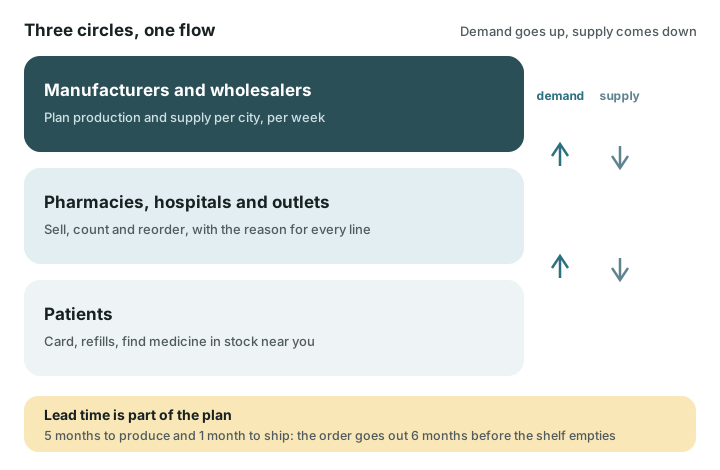
The three circles, bottom-up.
Patients
A refill is the first signal. Chronic medicines are bought on a schedule, and the card and the refill reminder keep that schedule visible.
Pharmacies, hospitals and outlets
Every sale updates stock. From sales speed, stock and delivery time the app writes a reorder with its reason, one order per distributor.
Manufacturers and wholesalers
Orders and demand for your own products roll up by city and week, so production and shipments follow real use.
Lead time is part of the plan.
Medicines are not ordered the day they run out. If a product takes 5 months to produce and 1 month to ship, the order has to go out 6 months before the shelf empties.
The outlook uses a lead time per supplier and product, from days to months, and the order-by date follows it.
Every suggestion says why.
| Product | Order | Why | From |
|---|---|---|---|
| Paracetamol 500 mg | 104 | Sells 6.9 a day, 20 left covers 3 days, delivery takes about 1 day | Tema Medical |
| Ibuprofen 400 mg | 48 | Sells 2.4 a day, 6 left covers 2 days, delivery takes about 1 day | Tema Medical |
| Amoxicillin 500 mg | 21 | Sells 2.1 a day, 14 left covers 7 days, delivery takes about 2 days | Accra Pharma |
Example figures. Each reason is built from your sales over the last 28 days, the stock you hold before it expires and the supplier's real delivery time.
Sell. See. Send.
- 1
Sell and count on a phone; every sale updates stock, even offline.
- 2
See the run-out date and the reason for each suggestion.
- 3
Send one basket. Each distributor gets its own order, and the delivery closes the loop.
See the three circles with your own products.
Bring your stock list. We show you the first reorder and what it means upstream.